Booth.Events Nano Banana Pro: The Complete Operator Guide to AI Prompts That Work
Booth.Events operators have one of the most powerful AI photo booth tools available — and almost no good prompt resources built for it. This is that guide. Everything you need to write Nano Banana Pro prompts that produce consistently premium results at real events.
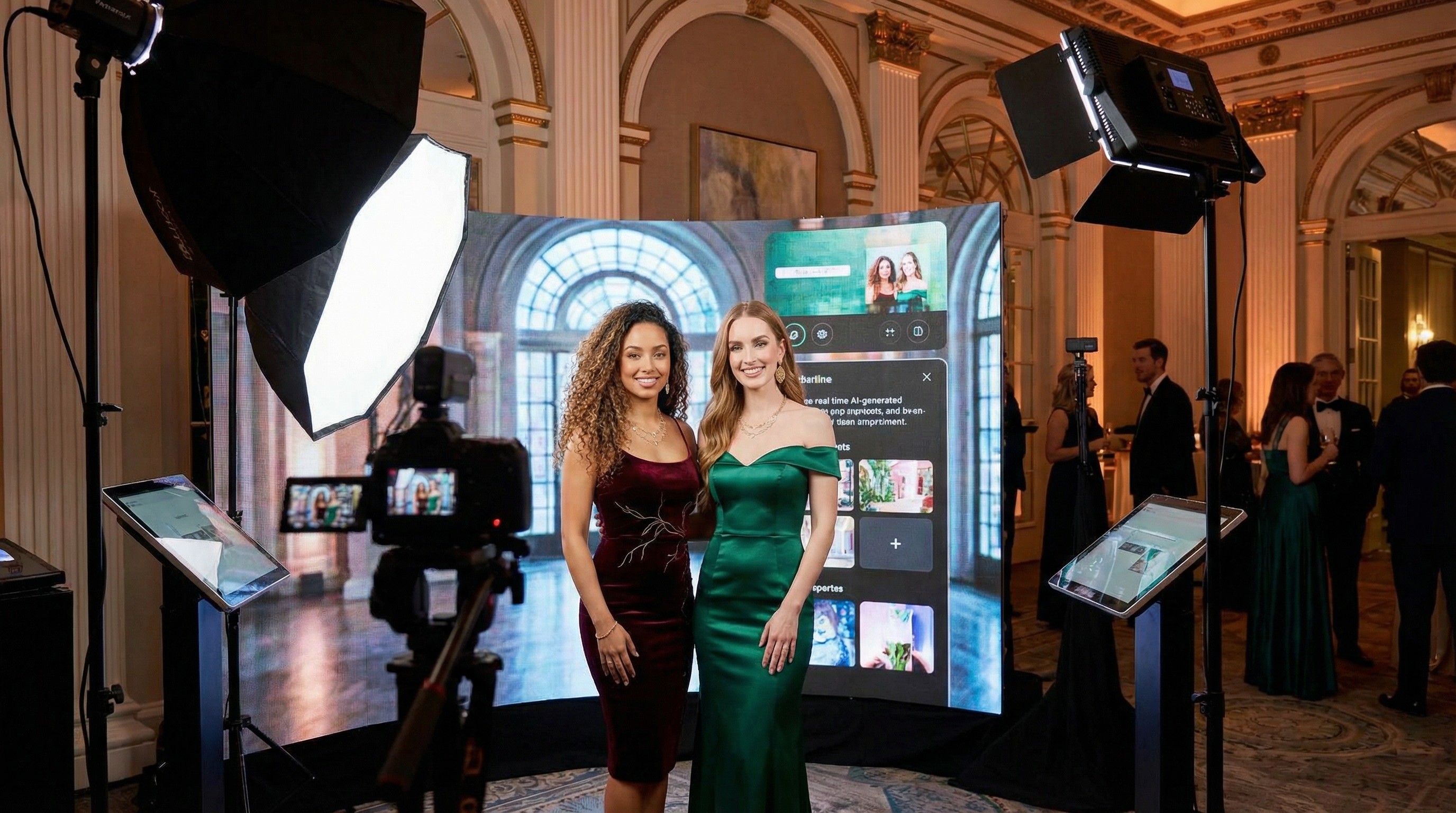
What Is Booth.Events Nano Banana Pro?
Nano Banana Pro is Booth.Events' AI photo transformation feature. Unlike basic filters that apply visual effects to an image, Nano Banana Pro processes the guest's actual photo alongside a text prompt and generates a transformed image that matches the prompt's description while (ideally) preserving the guest's identity.
Under the hood, Nano Banana Pro runs on Google's Gemini model architecture — which gives it some distinct characteristics compared to Snappic's BananaFX. The model's strengths include excellent natural language understanding, high image quality output, and strong performance with detailed scene descriptions. Its primary challenge is that it requires clear, explicit prompting to get consistent results.
Here's the critical thing most Booth.Events operators don't know: the prompting approach for Nano Banana Pro is fundamentally different from Snappic, LumaBooth, or any other photo booth platform. Using a Snappic-style prompt in Booth.Events will underperform. Using a LumaBooth-style weighted token prompt will actively confuse the model.
This guide covers exactly how to write prompts that unlock what Nano Banana Pro can actually do.
Generate a booth-ready prompt for your next event in under 60 seconds.
Try the Free Generator →How Nano Banana Pro Prompts Are Different
To understand why prompt syntax matters so much, it helps to understand how each platform processes prompts differently.
Snappic BananaFX
Long atmospheric narratives (150–250 words). Heavy on sensory detail, cinematic language, and layered scene construction. Works best with rich descriptive prose.
LumaBooth
AI Portraits presets (170+ styles, preset-driven) or legacy custom filter syntax with weighted tokens — (masterpiece:1.3), (cinematic:1.2). Shorter, structured, comma-separated when using custom fields.
Booth.Events Nano Banana Pro
Natural language descriptions. Clear, direct, 80–120 words. No token weights. Describe exactly what you want the output to look like — the model is reading it like instructions, not parsing tags.
TouchPix
Motion-optimized language. Emphasis on dynamic elements — "dynamic motion blur," "light trails," "particle systems." Built for animated output rather than static images.
Nano Banana Pro is closest to natural human language because the underlying Gemini model is a large language model at its core — it reads and understands clear English instructions better than it interprets weighted tokens or abstract atmospheric prose.
The Core Nano Banana Pro Prompt Formula
Every high-performing Nano Banana Pro prompt follows this structure:
- Transformation statement — What is happening to the guest? Be direct.
- Subject description — What does the guest look like in the output? Lighting, styling, expression.
- Environment/background — Where are they? What surrounds them?
- Style reference — What photographic or artistic style does this resemble?
- Identity preservation — Explicit instruction to maintain the guest's actual appearance.
Keep it between 80–120 words. If you're going longer, you're probably over-explaining — Nano Banana Pro handles clarity well but struggles with conflicting instructions stacked on top of each other.
Example Prompts by Style
Old Hollywood / Red Carpet
Magazine Cover Editorial
Garden Party Editorial
Cosmic / Starry Night
Vintage Film — 1970s
Important: Always include identity preservation language in every prompt. Nano Banana Pro handles this better than most platforms by default — but explicit preservation instructions still reduce variance significantly, especially for guests with non-Eurocentric features where AI models historically perform less consistently.
Common Nano Banana Pro Prompt Mistakes
Mistake 1: Using Weighted Token Syntax
Weighted tokens like (masterpiece:1.3) or (photorealistic:1.2) are for Stable Diffusion-based platforms (LumaBooth legacy custom filters). Nano Banana Pro doesn't parse these — it reads them as literal text. The result is an output that includes the text as noise rather than treating it as instructions.
Mistake 2: Prompts That Are Too Long
Unlike Snappic, which rewards richly detailed atmospheric narratives, Nano Banana Pro starts to degrade in consistency above ~150 words. Each additional instruction competes with the others. Keep it tight and clear.
Mistake 3: Conflicting Instructions
Don't tell the model to "preserve the guest's outfit exactly as worn" while also describing a new outfit in your transformation. The model will attempt to reconcile the conflict and usually produce an inconsistent result. If you want to transform clothing, omit the preservation instruction for that element. If you want to preserve it, don't describe a replacement.
Mistake 4: Omitting the Style Reference
Nano Banana Pro needs to know what photographic or artistic style to produce. "Put the guest in a garden" tells it the location. "Garden editorial photography in the style of Vogue Living" tells it the location and the visual quality level. The style reference is what elevates outputs from "looks fine" to "looks premium."
Mistake 5: Not Testing Before the Event
Every new prompt should be tested with at least 3–4 different input types (different skin tones, hair styles, glasses, groups vs. individuals) before the event. What works beautifully with one input type can struggle with another. Test the edge cases so you're not discovering them at 8pm at a wedding reception.
Why Booth.Events Is an Underserved Market
Here's something that should matter to you as an operator: there is currently almost zero quality prompt resource specifically built for Booth.Events Nano Banana Pro. Most prompt packs on the market (PromptCatalog, Etsy, Gumroad) target Snappic or general Stable Diffusion platforms.
This means two things:
- Your competitors using Booth.Events are probably running mediocre prompts — not because they don't care about quality, but because there's no good source to turn to. If you use well-crafted platform-specific prompts, your outputs will be visibly superior to what most Booth.Events operators are producing.
- Being an expert in Nano Banana Pro prompts is a genuine differentiator in your market. You can position yourself as the operator who gets the best results from Booth.Events — and back it up with sample images that prove it.
PBPrompts is currently one of the only prompt sources that generates output specifically optimized for Booth.Events. The free tool lets you select Booth.Events as your platform and generates natural-language prompts in the correct format — not Snappic prompts relabeled for Booth.Events, but actual Nano Banana Pro-optimized language.
Booth.Events vs. Snappic: Which Is Better for AI Booths?
This is a common question and the honest answer is: it depends on what you're optimizing for.
- Snappic BananaFX 2.0 is the most widely used AI photo booth system, meaning more operators, more community knowledge, and more third-party resources (including prompt packs). It's excellent and well-supported.
- Booth.Events Nano Banana Pro has a distinct image quality profile — some operators prefer the rendering quality for specific high-end styles (particularly editorial and fashion-adjacent transformations). The natural language prompting can also make it more intuitive for operators who find weighted token syntax confusing.
Many operators run both and use them for different event types. Understanding how to get the best from each platform is more valuable than picking one and ignoring the other.
For a full comparison of AI photo booth prompt sources across all platforms, see our platform comparison guide.
Get Booth.Events Prompts Built for Nano Banana Pro
The PBPrompts free generator creates natural-language prompts optimized specifically for Booth.Events — not generic prompts relabeled for the platform. Select Booth.Events, choose your style, get a prompt that works.
Generate Booth.Events Prompts → Browse Prompt PacksFrequently Asked Questions
What is Booth.Events Nano Banana Pro?
Nano Banana Pro is Booth.Events' AI photo transformation feature, powered by Google's Gemini model. It allows operators to write natural language prompts that transform guest photos in real time. Unlike Snappic's BananaFX, Nano Banana Pro processes the reference image with the prompt simultaneously, requiring a natural language prompting approach.
What prompt style works best for Booth.Events Nano Banana Pro?
Nano Banana Pro responds best to clear, natural language descriptions between 80–120 words. Describe the transformation directly — what the output should look like, what surrounds the subject, what photographic style it should resemble. Always include identity preservation language. Avoid weighted token syntax (masterpiece:1.3) — those are for Stable Diffusion-based platforms, not Gemini.
How do I preserve the guest's identity in Booth.Events Nano Banana Pro?
Include explicit identity preservation language in every prompt: "Preserve the subject's exact facial features, skin tone, bone structure, and natural proportions exactly as photographed. Do not beautify, stylize, or alter facial characteristics." Nano Banana Pro handles identity better than some platforms, but explicit language reduces variance significantly.
Can I use the same prompts for Booth.Events and Snappic?
No. The prompt syntax is fundamentally different. Snappic BananaFX uses long atmospheric narratives. LumaBooth uses AI Portraits presets or weighted token syntax in legacy custom filters. Booth.Events Nano Banana Pro uses natural language descriptions. Using a Snappic prompt in Booth.Events will significantly underperform. PBPrompts generates platform-specific prompts automatically — just select your platform in the free tool.
Where can I get ready-made prompts for Booth.Events?
PBPrompts is currently one of the only sources offering prompts specifically written and tested for Booth.Events Nano Banana Pro. Use the free generator by selecting Booth.Events as your platform, or browse the prompt pack shop for downloadable PDF packs including platform-specific versions.
Generate a booth-ready prompt for your next event in under 60 seconds.
Try the Free Generator →Get Booth.Events Prompts That Actually Work
Browse downloadable prompt packs built and tested for Booth.Events — or go Pro for instant on-demand generation across Nano Banana Pro, Snappic, LumaBooth, TouchPix, and more.
Browse Prompt Packs in the Shop Upgrade to Pro for Premium ToolsAbout the Author: Liz Colon is the founder of PBP and a working photo booth operator at Captured Celebrations in LA County. She tests prompts across every major photo booth platform at real events before adding them to PBPrompts.