AI Photo Booth Transformation vs. Generic Filters: Why the Difference Determines Who Wins in 2026
Something shifted in the photo booth industry in 2025. Guests stopped being impressed by AI that did something to their photo — and started expecting AI that did something for them. The operators who understand this distinction are commanding premium pricing. The ones who don't are watching their bookings flatten.
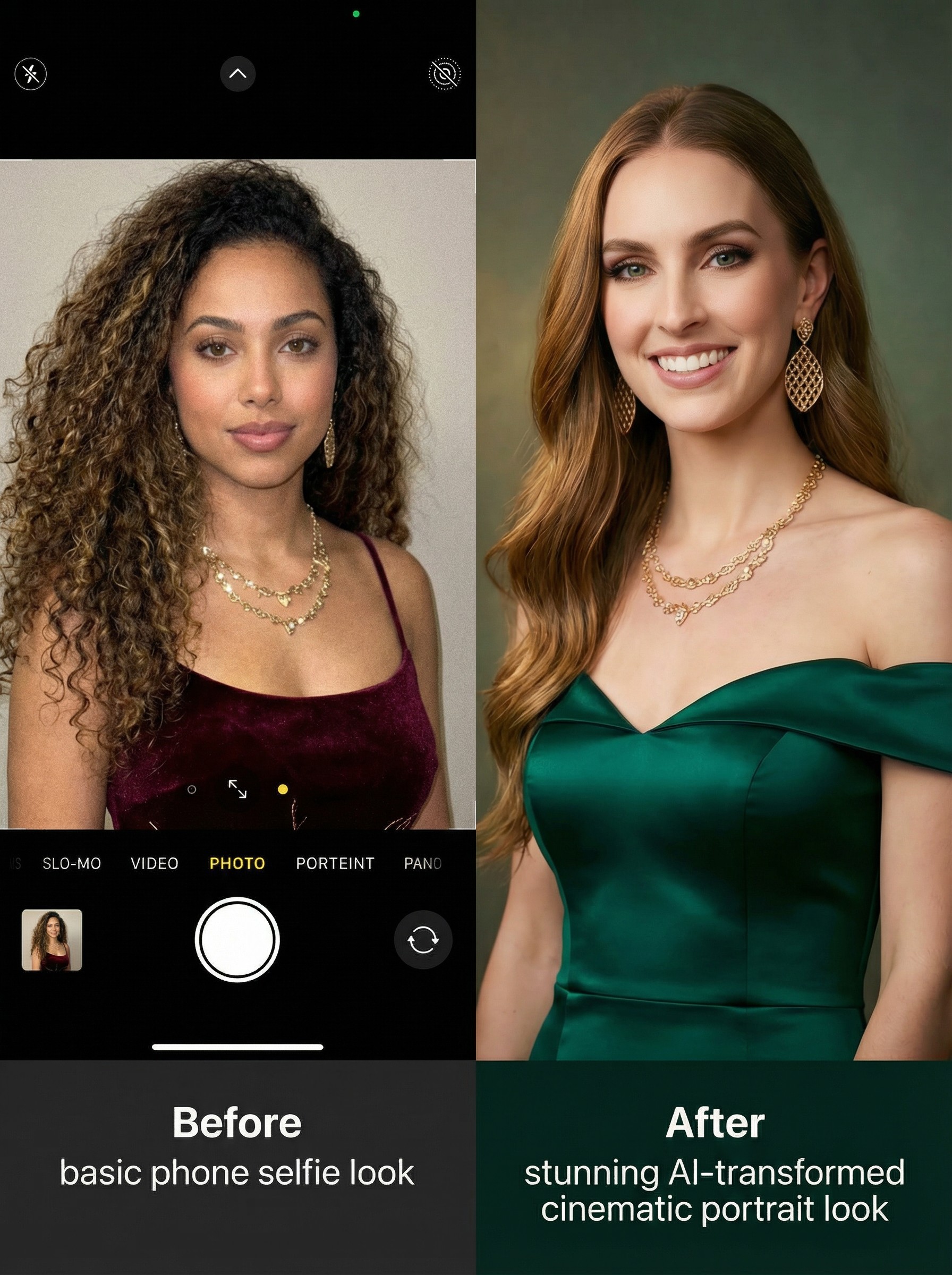
What's Actually the Difference?
The words "filter" and "transformation" get used interchangeably in the photo booth industry, but they describe fundamentally different things — and that difference is exactly what clients and guests are starting to respond to.
A Filter Does This
Applies an effect on top of an existing photo. Color grades the image. Softens skin. Adds a graphic overlay. Puts vintage grain over the frame. The original photo is still there — it just looks different. The guest is in the same location, same pose, same context.
A Transformation Does This
Generates a new image interpretation from the guest's photo. Places the guest inside a completely different scene, style, or story. The guest appears as a magazine cover model, a 1940s film star, a cosmic nebula figure. They're still recognizably themselves — but they're somewhere entirely new.
The practical distinction: a filter makes your photo look better. A transformation makes you part of a story.
Guests have phones with excellent filter apps. They've had Instagram filters for a decade. They have Snapchat beauty filters. They don't need to go to your photo booth to get a "better-looking" version of themselves. What they can't do on their phone is become the cover of Vogue, or stand inside a cosmic nebula, or be rendered as a 1940s Hollywood star in a dramatic studio portrait. That's what a real AI transformation delivers.
Generate a booth-ready prompt for your next event in under 60 seconds.
Try the Free Generator →When the Shift Happened
In 2023, any AI photo booth experience was impressive. Guests had never seen real-time AI transformation at an event, and the novelty alone was enough to drive excitement regardless of output quality.
By mid-2024, AI photo booths had appeared at enough events that guests had a frame of reference. They'd seen "Comic Book Hero" three times. They'd seen the Snappic presets. The novelty had worn off, and they were starting to evaluate outputs on quality, not just existence.
By 2025, the market segmented. Operators with premium prompts and distinctive styles were booking at $1,500–$2,500+. Operators running default presets were fielding questions like "is this going to be like that thing everyone has?" and losing bookings to competitors who could show something genuinely impressive.
By spring 2026, the research is clear: "Transformation over Template" is the dominant operator philosophy among top-performing photo booth businesses. Guests don't want an experience. They want their experience — something that feels built specifically for them, for this event, producing a result they've never seen before.
Why Generic Outputs Are a Business Problem
The problem with generic AI photo booth outputs isn't just aesthetic — it's commercial.
Problem 1: You Can't Charge Premium for Commodity
When a client can book "an AI photo booth" from five different operators in your market and get similar results from all of them, price becomes the differentiator. You end up in a race to the bottom against operators willing to undercut on price.
When your outputs are visibly superior — when a client sees your Magazine Cover output next to a competitor's generic filter result and the difference is obvious — price stops being the primary conversation. You're justifying a premium, not defending a price.
Problem 2: Generic Outputs Don't Get Shared
Social sharing is the highest-value outcome a photo booth can produce. A guest who shares their AI transformation to Instagram, TikTok, or a wedding Facebook group is generating free marketing to exactly the people most likely to hire you — their social network, which includes other event planners, future brides, corporate event managers.
Generic filter outputs don't get shared. They look like phone app outputs. There's no "you have to see what the photo booth did to me" moment. Premium transformations — the magazine cover that genuinely looks editorial, the Old Hollywood portrait that looks like it came from a real studio — those get shared.
Problem 3: Generic Outputs Hurt Referrals
Photo booth referrals are primarily driven by a guest saying to a future event planner: "you should book the company that did the AI thing at [friend's wedding] — the results were incredible." That recommendation requires the outputs to be memorable. Memorable means surprising, impressive, and personal — which generic outputs are not.
The Three Elements of a True Transformation
Not every AI photo booth output that isn't a literal filter is a true transformation. There are outputs that look like transformations but still feel generic — and clients notice. A true transformation has three characteristics:
1. Identity Preservation
The guest must be recognizable in the output. An AI transformation that produces a beautiful output but looks nothing like the actual guest is a failed experience. The moment a guest says "that doesn't look like me" is the moment the booth stops being a premium experience and becomes a tech gimmick.
This is why identity preservation language in prompts matters so much — not as a technical nicety, but as a fundamental business requirement. Guests want to be the protagonist of the story, not a stand-in. They should be able to share the output and have their friends immediately recognize them.
Every prompt in PBPrompts includes identity preservation language by default: explicit instructions for the AI model to preserve exact bone structure, skin tone, hair texture, facial proportions, and natural expressions. This isn't optional — it's the baseline.
2. Theme Matching
A transformation feels personal when it matches the event's actual aesthetic, not a default style. A Magazine Cover transformation at a fashion brand's product launch feels perfectly placed. The same Magazine Cover output at an elementary school birthday party feels generic — even if the output is technically excellent.
The operator's job is to select and customize styles that fit the specific event context. This requires understanding what the client cares about, what the guests expect, and what aesthetic vocabulary the event is using. It also requires having a library of styles deep enough to actually match diverse events — which is why the range of styles available matters.
3. Output Quality
A transformation can preserve identity and match the theme but still fall flat if the output quality is mediocre. Blurry backgrounds. Inconsistent lighting. Artifacts. Skin that looks processed. These are the outputs that guests politely take, don't share, and forget.
Output quality is largely a function of prompt quality. The difference between a prompt that produces consistently premium outputs and one that produces inconsistent mediocre ones is real and significant — which is the entire reason that well-crafted, tested prompts are worth paying for.
The transformation test: Would a guest at your event see the output and immediately say "I need to show my friends"? If yes, it's a transformation. If the response is "oh, that's cool" and they pocket their phone, it's a filter.
What Operators Who Are Winning Are Doing Differently
Across the photo booth industry in 2026, the operators booking premium events consistently share a few common practices:
They Present Visual Samples in Sales Conversations
The operators closing $2,000+ bookings aren't describing AI photo booths in proposals — they're showing them. A printed PDF or iPad presentation with 3–5 curated sample outputs specific to the event type closes faster than any written description. The client sees exactly what their guests will experience, and the quality difference from competitors is immediately obvious.
They Offer Customization as a Feature
The phrase "we'll customize the AI experience to match your theme" is worth $200–400 in immediate perceived value. Even if the customization is choosing from your existing library rather than building something from scratch, framing it as custom to the event positions you as a specialist rather than a commodity.
They Test Every Style Before the Event
No serious operator runs an untested prompt at a premium event. Testing means running the prompt with multiple different input types — different skin tones, hair styles, face shapes, glasses, groups — and confirming consistent quality across all of them. The time investment is an hour or two per new style. The insurance value is avoiding a catastrophic output failure at an event where the client is watching over your shoulder.
They Update Their Style Library Seasonally
Operators who offer the same 5 styles year-round have clients who "already saw the AI booth at [other event]." Operators who introduce new styles quarterly have clients who come back specifically to see what's new. See our Spring 2026 trend guide for the styles worth adding now.
They Use Platform-Optimized Prompts
The same style prompt produces dramatically different results on Snappic vs. LumaBooth vs. Booth.Events. Operators who use platform-appropriate prompts get consistently better outputs than those who copy-paste the same prompt across different software. This is one of the core things PBPrompts handles — every generated prompt is written for the specific platform you're using.
The Investment Calculus
Let's be practical about what we're talking about here.
A photo booth operator who upgrades from generic presets to premium, platform-optimized prompts might invest $25/month in PBPrompts Pro. If that investment helps close one additional booking per month at a $1,500 average — or moves one booking from a $800 standard package to a $1,300 premium package — the ROI is immediate and significant.
The math isn't complicated. The question is whether the investment in prompt quality translates to booking quality. The operators who've made that shift consistently say yes.
The alternative — competing on price with commodity AI experiences — leads to a market where your ceiling is determined by what the cheapest operator in your area is willing to accept. That's not a business strategy worth committing to.
Getting Started With Real Transformations
The quickest way to understand the quality difference between a filter and a genuine transformation is to generate one and run it in your actual booth software. PBPrompts' free prompt generator creates platform-optimized prompts with no account required — select your platform, choose a style, and get a prompt you can test today.
For operators who want to go deeper — building a style library across multiple event types, having the sales PDFs that close bookings, and getting access to seasonal style drops — the Pro subscription gives you 25 generations a day across all platforms for one flat monthly rate.
The shift from filters to transformations is already happening across the industry. The operators who make it intentionally — building premium prompt libraries, presenting impressive samples, and delivering genuinely memorable results — are the ones who will define what AI photo booths are capable of for the next few years.
Generate a Real Transformation Right Now
Try the PBPrompts free generator — no account needed. Select your platform, choose a style, and see what a platform-optimized prompt actually produces compared to a default preset.
Generate Free Prompt → Browse Prompt PacksFrequently Asked Questions
What is the difference between AI photo booth transformation and a filter?
A filter applies a visual effect on top of an existing photo — color grading, skin smoothing, or graphic overlays. An AI transformation generates a new image based on the guest's photo and a text prompt, placing the guest in a completely different scene, style, or context. Filters are additive; transformations are generative. The guest's face appears in both, but a transformation puts them inside a new visual story.
Why are guests rejecting generic AI photo booth filters?
Guest expectations have risen rapidly as AI photo booths have become standard at events. Guests who attended events in 2024 and 2025 have already experienced generic filter-style AI booths. They want something different — a result that feels genuinely personal and impressive, not a preset effect every other operator is offering. The novelty of any generic AI filter wears off quickly.
How do good AI photo booth prompts create transformation instead of just filtering?
Good AI prompts instruct the model to place the guest in a specific scene, style, or context — not just apply an effect. A Magazine Cover prompt doesn't filter the image; it generates a new image where the guest is the subject of a high-fashion editorial shoot. The difference is between "add a vintage tone" (filter) and "transform this person into a 1940s Hollywood film star in a dramatic studio portrait" (transformation).
What makes an AI photo booth transformation feel personal vs. generic?
Three things: identity preservation (the guest recognizably looks like themselves), theme matching (the style matches the event's actual aesthetic), and output quality (the result looks premium, not like a phone app filter). Generic outputs fail on at least one of these — usually all three. Platform-optimized prompts with identity preservation language are the foundation for all three.
Generate a booth-ready prompt for your next event in under 60 seconds.
Try the Free Generator →Stop Running Generic Presets — Start Running Transformations
Explore the full prompt pack library and find styles built for real transformations at real events. Or go Pro for 25 on-demand prompts a day across every platform and event type.
Explore the Full Pack Library Get Premium Tools with ProAbout the Author: Liz Colon is the founder of PBP and a working photo booth operator at Captured Celebrations in LA County. She's been running AI photo booths at real events since the technology became viable and has watched the market shift firsthand.